
From CCS2 to NACS: Understanding Charging Interface Standards for Global Markets
For dealers and buyers planning to export Chinese electric vehicles to international markets, understanding global charging interface standards is crucial. This comprehensive guide breaks down the major charging standards including CCS2, NACS, CHAdeMO, and GB/T, helping you ensure your affordable Chinese used car can charge seamlessly in your target market.
Global Charging Standards Overview
The Four Major Standards
1. GB/T (Chinese Standard) - Region: Mainland China - AC Charging: GB/T 20234.2 - DC Charging: GB/T 20234.3 - Max Power: 250kW (up to 500kW future)
2. CCS2 (European Standard) - Region: Europe, Australia, New Zealand, parts of Asia - Combined Charging System - Max Power: 350kW+ - Backward compatible with Type 2 AC charging
3. NACS (North American Charging Standard) - Region: North America (USA, Canada, Mexico) - Formerly: Tesla proprietary connector - Max Power: 250kW (V3 Supercharger) - Becoming industry standard from 2024
4. CHAdeMO (Japanese Standard) - Region: Japan, some Asian markets - Primarily Nissan, Mitsubishi - Max Power: 400kW (CHAdeMO 3.0) - Declining market share
Regional Charging Standards Detailed
European Market: CCS2 Dominance
Standard: CCS2 (Combined Charging System Type 2)
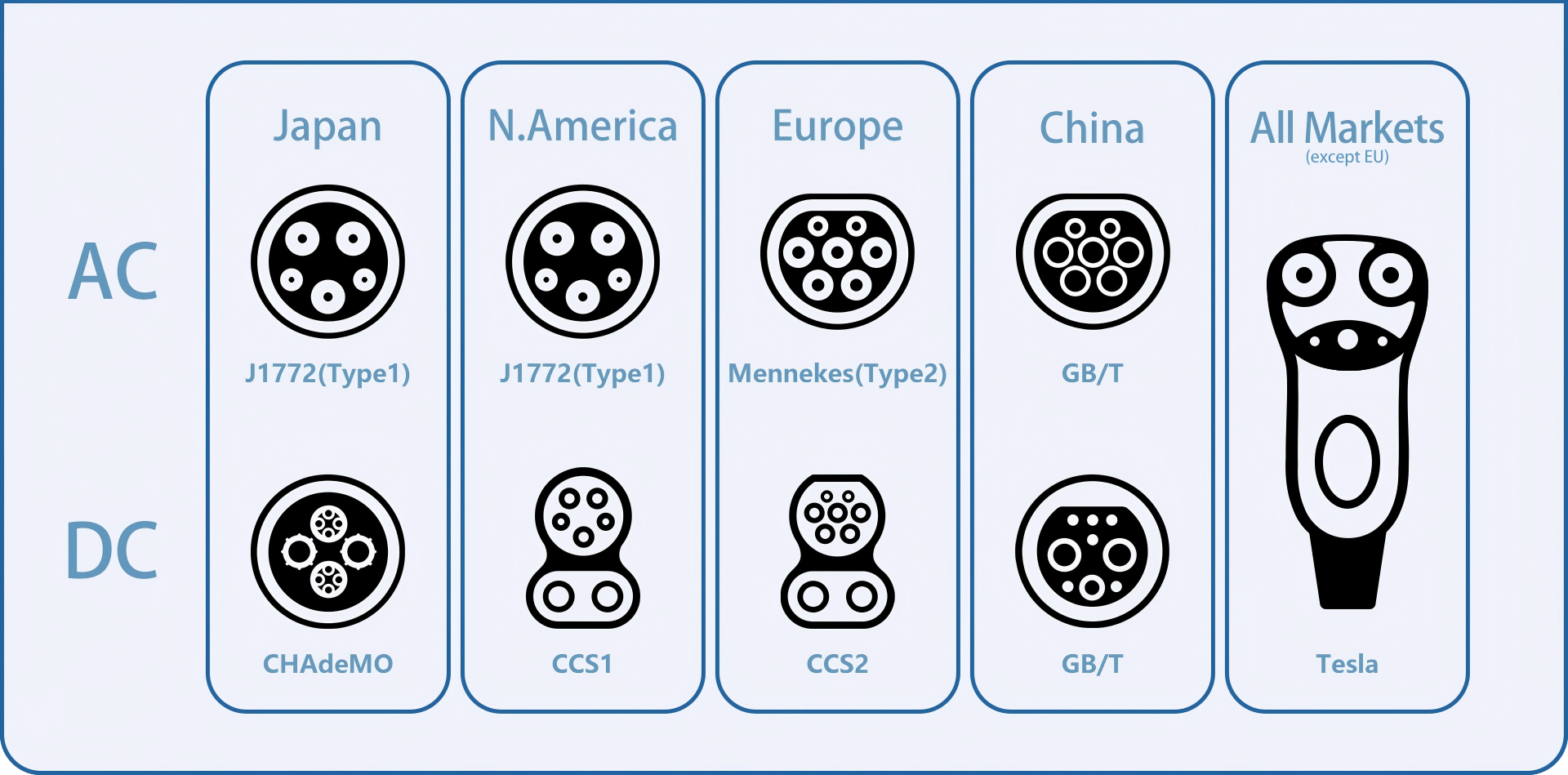
Technical Specifications: - AC Charging: Type 2 (Mennekes) plug - DC Fast Charging: CCS2 combo plug - Voltage Range: 200-1000V - Current: Up to 500A - Power: Up to 350kW
Chinese EV Adaptation:
BYD in Europe: - BYD Han: CCS2 standard - BYD Tang: CCS2 equipped - BYD Seal: CCS2 compatible - BYD Dolphin: CCS2 ready
NIO in Europe: - NIO ET7: CCS2 + Battery Swap - NIO EL7: CCS2 compatible - NIO ET5: CCS2 standard
XPeng in Europe: - XPeng G9: CCS2 interface - XPeng P7: CCS2 adapted version
Conversion Requirements: - GB/T to CCS2 retrofit: €800-€1,500 - Includes hardware and software updates - Must be performed by certified technicians - Requires re-certification
Charging Networks: - Ionity (highway network) - Fastned - Allego - Tesla Superchargers (partially open to non-Tesla)
North American Market: The NACS Revolution
Standard: NACS (North American Charging Standard)
Historical Context: - Pre-2022: Tesla proprietary - November 2022: Tesla opens standard - 2024: Ford, GM, Rivian adopt - 2025: Expected to become US standard
Technical Specifications: - Compact design (50% smaller than CCS) - Integrated AC and DC - Max Power: 250kW (V3) / 1MW (V4 planned) - Voltage: Up to 1000V - Lighter cables
Chinese EV Entry Strategy:
Option 1: Dual-Port Configuration - Retain GB/T for Chinese market - Add NACS for North America - Cost: $1,200-$2,000 per vehicle
Option 2: Full NACS Conversion - Remove GB/T - Install NACS as primary - Cost: $800-$1,500 per vehicle
Option 3: Adapter Solution - Use CCS1 to NACS adapter - Temporary solution - Cost: $200-$400 - May limit charging speed
Key Considerations:
BYD North American Strategy: - Plans to enter US market 2025 - Likely NACS adoption - Mexico factory production
NIO North American Plans: - Paused US market entry - Focus on Europe and China - Would require NACS if entering
XPeng North American Ambitions: - Exploring US market - G9 likely first model - NACS adaptation necessary
Charging Network Access: - Tesla Supercharger network (17,000+ stations) - Electrify America (transitioning to NACS) - EVgo (planning NACS support) - ChargePoint (adding NACS)
Australia and New Zealand: CCS2 Standard
Standard: CCS2 (same as Europe)
Market Characteristics: - Right-hand drive requirement - Strict safety standards - Growing charging network - Government EV incentives
Chinese EV Adaptation: - Use European-spec vehicles - CCS2 already equipped - Right-hand drive conversion necessary - Cost: $3,000-$8,000 per vehicle
Major Charging Networks: - Chargefox - Evie Networks - NRMA (Australia) - ChargeNet (New Zealand)
Southeast Asia: Mixed Standards
Primary Standards: - Thailand: CCS2 + GB/T - Singapore: CCS2 dominant - Malaysia: CCS2 + CHAdeMO - Indonesia: CCS2 emerging - Philippines: Mixed standards
Chinese EV Advantages: - Native GB/T support - Easy CCS2 adaptation - Competitive pricing - Right-hand drive availability
Recommended Configuration: - Dual-standard support (GB/T + CCS2) - Flexible charging options - Future-proof approach
Middle East: Emerging Market
Current Status: - UAE: CCS2 + CHAdeMO - Saudi Arabia: CCS2 adoption - Qatar: Mixed standards - Kuwait: Limited infrastructure
Challenges: - Extreme heat conditions - Limited charging networks - Luxury brand preference - Infrastructure development
Opportunities: - Government EV push - Smart city projects - Renewable energy integration
Technical Deep Dive
CCS2 vs NACS: Technical Comparison
| Feature | CCS2 | NACS |
|---|---|---|
| Physical Size | Larger, heavier | Compact, lightweight |
| Max Power | 350kW+ | 250kW (V3) / 1MW (V4) |
| Voltage Range | 200-1000V | Up to 1000V |
| AC/DC | Combined plug | Integrated design |
| Ease of Use | Heavier cables | Lighter, easier |
| Network Coverage | Extensive in Europe | Growing in North America |
| Cost | Higher | Lower |
GB/T to CCS2 Conversion
Hardware Requirements: 1. Charging port replacement 2. Onboard charger update 3. Battery Management System (BMS) reprogramming 4. Communication protocol adaptation
Software Updates: - CCS2 communication protocols - Charging curve optimization - Safety parameter adjustments - User interface updates
Certification Requirements: - CE marking (Europe) - EMC (Electromagnetic Compatibility) testing - Safety certifications - Charging interoperability tests
GB/T to NACS Conversion
Technical Challenges: - Different communication protocols - Voltage and current management - Thermal management systems - Safety interlock mechanisms
Conversion Process: 1. Vehicle compatibility assessment 2. Hardware modifications 3. Software reprogramming 4. Testing and validation 5. Certification
Cost Breakdown: - Hardware: $500-$1,000 - Labor: $300-$500 - Certification: $200-$400 - Total: $1,000-$1,900 per vehicle
Chinese EV Brands' Global Charging Strategies
BYD: Multi-Standard Approach
Europe: - All models equipped with CCS2 - Partnership with Ionity - Own charging network expansion
North America: - Awaiting NACS adoption - Mexico production base - Potential Tesla Supercharger access
Southeast Asia: - GB/T + CCS2 dual standard - Regional charging partnerships - Infrastructure investment
NIO: Battery Swap Advantage
Unique Approach: - Battery swap station network - Reduces charging standard dependency - 3-5 minute battery exchange
Global Expansion: - Europe: Swap stations in 13 countries - Norway: First overseas market - Germany, Netherlands, Sweden expansion
Charging Compatibility: - CCS2 for plug-and-charge - Battery swap as primary method - Flexible energy solution
XPeng: Software-First Strategy
Smart Charging: - AI-optimized charging - Route planning integration - Real-time charging station info
Standard Adaptation: - Europe: CCS2 - North America: NACS ready - China: GB/T native
Technology Innovation: - 800V architecture - Ultra-fast charging (480kW) - Vehicle-to-Grid (V2G) capability
Practical Guide for Exporters
Step 1: Identify Target Market
Research Requirements: - Charging standards - Certification requirements - Import regulations - Market demand
Step 2: Assess Vehicle Compatibility
Technical Audit: - Current charging system - Electrical architecture - Software capabilities - Modification feasibility
Step 3: Choose Conversion Strategy
Options: - Full conversion - Dual-standard configuration - Adapter solution - Market-specific versions
Step 4: Find Certification Partners
Essential Services: - Technical conversion - Testing and validation - Certification support - After-sales service
Step 5: Establish Charging Partnerships
Network Access: - Charging network operators - Roaming agreements - Payment system integration - Customer support
Cost Analysis
Per-Vehicle Conversion Costs
GB/T to CCS2: - Hardware: €600-€1,000 - Labor: €200-€500 - Certification: €200-€400 - Total: €1,000-€1,900
GB/T to NACS: - Hardware: $500-$900 - Labor: $300-$500 - Certification: $200-$400 - Total: $1,000-$1,800
Dual-Standard Configuration: - Additional hardware: $800-$1,500 - Complex installation: $400-$700 - Extended testing: $300-$500 - Total: $1,500-$2,700
Economies of Scale
Bulk Conversion (100+ vehicles): - 20-30% cost reduction per vehicle - Volume purchasing discounts - Streamlined certification - Faster turnaround time
Future Trends
Standard Consolidation
Predictions: - NACS dominance in North America - CCS2 continues in Europe/Asia - GB/T remains in China - CHAdeMO phase-out
Technology Advances
Coming Soon: - Megawatt charging (1MW+) - Wireless charging standards - Plug & Charge (PnC) - Vehicle-to-Grid (V2G) standardization
Policy Developments
Government Initiatives: - Standardization mandates - Interoperability regulations - Charging infrastructure investment - Cross-border charging agreements
Frequently Asked Questions
Can I use a GB/T adapter in Europe?
Short Answer: Not recommended for regular use.
Detailed Explanation: - Adapters exist but unreliable - Safety concerns - Limited charging speeds - Not compliant with regulations - Proper conversion better
Will NACS replace CCS2 globally?
Short Answer: Unlikely worldwide.
Detailed Explanation: - NACS: North American standard - CCS2: Europe/Asia remains - Regional standards will persist - Cross-region vehicles need adaptation
Does conversion affect warranty?
Short Answer: Depends on who performs it.
Detailed Explanation: - Manufacturer-authorized: Warranty maintained - Third-party: May void warranty - Certified converters: Usually acceptable - Always check manufacturer policy
Which standard is best for global export?
Short Answer: CCS2 offers widest coverage.
Detailed Explanation: - CCS2: Europe, Australia, parts of Asia - NACS: North America growing - GB/T: China and some Asia - Multi-standard most flexible
Conclusion
Understanding global charging standards is essential for successfully exporting Chinese electric vehicles. While conversion from GB/T to CCS2 or NACS requires investment, it opens lucrative international markets for affordable Chinese used cars.
Key Takeaways:
1. Europe/Australia: CCS2 is mandatory 2. North America: NACS becoming standard 3. Southeast Asia: Mixed approach best 4. Conversion Costs: $1,000-$2,000 per vehicle 5. Economies of Scale: Bulk conversion saves 30%
Chinese manufacturers like BYD, NIO, and XPeng are actively adapting to global charging standards, making international expansion easier than ever. With proper planning and execution, exporters can successfully navigate the complexities of charging standards and capture market share in the global EV market.
As charging technology continues to evolve and standards consolidate, staying informed and working with certified partners will be crucial for long-term success. The future belongs to those who can adapt flexibly and provide seamless charging experiences for customers, regardless of where they are in the world.
---
Ready to export your Chinese EVs to global markets? Visit WinMinCar for expert guidance, certified partners, and comprehensive export support services.